



Whilst more women are diagnosed with mental health conditions, the mental health issues of men often go under the radar and lead to more severe outcomes.
“Anxiety and depression are the most common challenges for men today,” affirms Mary Spillane, Clinical Psychologist and Headspace App’s Mental Health Expert. “Men tend to be less likely to seek professional support than women, which can also lead to challenges around managing their mental health.”
For International Men’s Day 2022, we spoke to Stephen Smyth of Island Aggregates, a construction firm based in the Isle of Man, to learn more about the stigma attached to mental health in what is still a heavily male-dominated industry, and what they as an organisation are doing to change that.
What is the percentage of men vs. women employed by your organisation?
Around 10% of our employees are female, this includes office based staff. However, in operational roles the figure is lower at just 5%. So 90% of our workforce are men.
The construction industry is undoubtedly still a largely male dominated industry. In your opinion, how do men working in the sector perceive mental health? Are many still reluctant to acknowledge and admit when they are experiencing mental health difficulties, let alone talk about them to others?
Things are improving. But yes, it’s certainly a male dominated sector and the perceived “macho” culture that creates can prevent many from seeking help and support when they may need it, putting further pressures on their own mental health.
A 2020 report by the Chartered Institute of Building found that in the UK, 26% of construction industry professionals thought about taking their own lives, 56% work for organisations with no mental health policies in the workplace, and 87% experienced anxiety. These are statistics which have to change!
In your opinion, has the stigma of mental illness remained the same or decreased from its perception five years ago and if so, what has changed?
It’s definitely decreasing, which is a great thing. Especially since the events of the past few years, the pandemic and currently cost of living pressures make for increased stress levels across the population. Responsible employers now recognise mental health as a vital element of health & safety, providing training and raising awareness. It’s the sort of area where the work will never be complete, but we have to keep at it and bit by bit, reduce the stigma.
Males continue to account for three-quarters of suicide deaths registered in 2021. In your opinion, is it important for co-workers and employers to recognize the signs of mental illness? Why or why not?
This is vitally important. The earlier signs can be spotted, the earlier the conversation can begin. And that intervention can make such a big difference.
How do you as an employer help your employees remain productive and access treatment if battling mental illness?
If someone comes forward with a health issue, mental or otherwise, this will always be looked upon sympathetically. We will always try to facilitate treatment where appropriate. Extra support can be provided privately and confidentially via our mental health first aiders, or externally if needed. If a change of job role is possible, on a temporary or permanent basis and would help the situation, this can also be looked at.
Does your business recognise the importance of a healthy work-life balance? How do you encourage this within your organisation and among your employees?
It’s very important. It is something we have to be mindful of and always seek to improve, both for our managers and also our depot staff. We’re a customer service business in a fast-moving environment and sometimes there can be early starts and days can run on – we have to be mindful of the hours our team are working. We do try to give a little back, for example a Saturday bonus scheme entitles employees to an extra days leave after a certain number of Saturday mornings are worked.
And we’re beginning to do a bit more on this front through a ‘Well-Together’ committee which, based on employee feedback, runs well-being initiatives. In the past we’ve run online fitness sessions, a quiz night and a stress & sleep management workshop. We’ve a fishing trip planned for next spring which is well subscribed.
Does your organisation have a process that allows for open communications between managers, supervisors and employees that helps to address the needs of co-workers who are traumatised by personal or workplace issues?
Yes, this is very important and I can think of a number of situations like this over the past couple of years. Some can be dealt with locally, others require a more formal approach and we’re supported by HR professionals in this respect. While situations like this are often not easy or straightforward, I take comfort in the fact that our people feel they can bring the issues to the fore, rather than bottling things up.
What resources in your organisation and/or community exist for employees struggling with mental health issues?
We hold training and awareness sessions which are delivered across the business, usually to coincide with an event like Mental Health Awareness Week. In addition we have had a trained Mental Health First Aider, I know they have had confidential conversations with some of our team in the past.
This year we decided to expand this provision and we now have First Aiders at all of our operational sites. They’re trained to spot the signs that employees are struggling mentally and everyone is encouraged to begin the conversation, if they need to.
We also provide all of our employees with a free health compensation plan. As well as getting them some money off things like dental and opticians bills, the plan includes a free helpline for all health matters including mental health.
Does your organisation work to prevent physical, relational or emotional harassment, bullying or aggression? If so, how?
We have polices covering all of these areas, the bottom line being that no-one should be subject to this sort of behaviour in the workplace. If anything comes to light, it is quickly dealt with, using our disciplinary procedures if necessary.
As an organisation, you recently undertook a campaign with a local mental health charity, Isle Listen. Tell us more about the campaign and the reasons behind it.
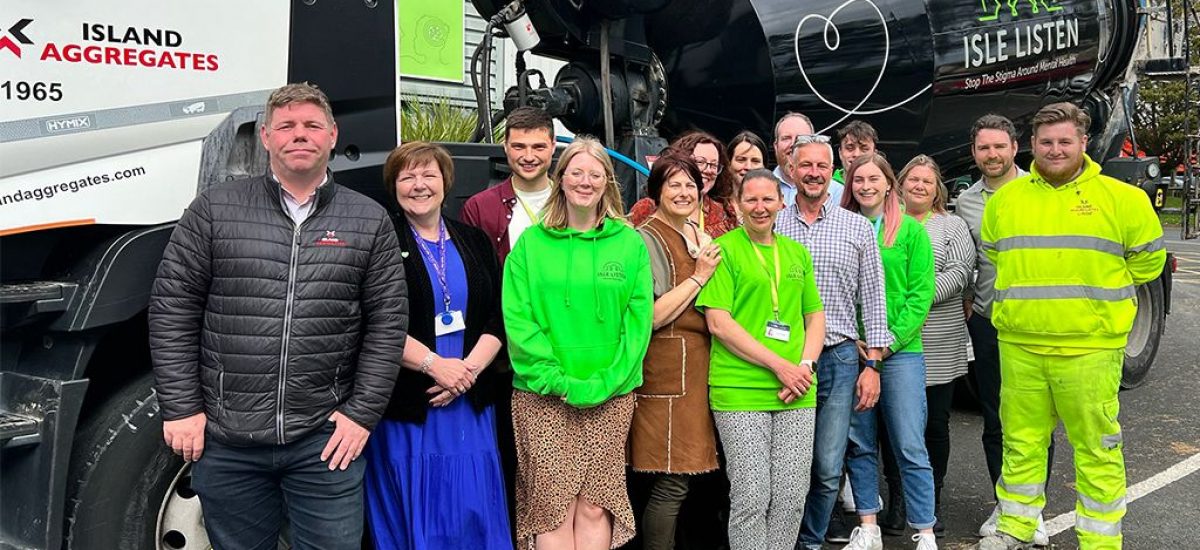
Really just for all the reasons listed above. We’ve re-branded some of our concrete mixer trucks with dual Island Aggregates and Isle Listen livery, with the message ‘Stop the Stigma Around Mental Health’. One took part in the Douglas Carnival and they were on display at the Royal Manx Agricultural Show. These trucks being around reinforces the attitude we’re trying to instil in our own team, plus the trucks are out and about on the roads and, importantly, on construction sites the length and breadth of the island. If this ongoing initiative raises awareness even a little bit, or encourages just one construction worker to reach out over mental health issues, it will be worthwhile.


Art on Yachts –Preference vs Practicality
November 17 2022
Yacht Ownership - A Sea of Opportunity
November 21 2022
Are you ready to make sense of your future?
Get in touch